GO THROUGH THESE VIDEOS FIRST
https://www.youtube.com/watch?v=YkdQB0JnJD4&list=PL9RcWoqXmzaLlfmNg2Ku1SdZtvXnYrLbc&index=4
https://www.youtube.com/watch?v=AzICg5-Whlo&list=PL9RcWoqXmzaLlfmNg2Ku1SdZtvXnYrLbc&index=8
https://www.youtube.com/watch?v=c6woVjcC-q8&list=PL9RcWoqXmzaLlfmNg2Ku1SdZtvXnYrLbc&index=9
https://www.youtube.com/watch?v=c6woVjcC-q8&list=PL9RcWoqXmzaLlfmNg2Ku1SdZtvXnYrLbc&index=9
https://www.youtube.com/watch?v=Gtd-eLxtP7Y
UNIT -2
Stress: stress is defined as the force intensity or force per unit area. Here we use a symbol s to represent the stress.

Units :
The basic units of stress in S.I units i.e. (International system) are N / m2 (or Pa)
MPa = 106 Pa
GPa = 109 Pa
KPa = 103 Pa
TYPES OF STRESSES :
only two basic stresses exists :
(1) normal stress and
(2) shear shear stress.
Normal stresses : We have defined stress as force per unit area. If the stresses are normal to the areas concerned, then these are termed as normal stresses. The normal stresses are generally denoted by a Greek letter ( s )

Tensile or compressive stresses :
The normal stresses can be either tensile or compressive whether the stresses acts out of the area or into the area

Shear stresses :Let us consider now the situation, where the cross – sectional area of a block of material is subject to a distribution of forces which are parallel, rather than normal, to the area concerned. Such forces are associated with a shearing of the material, and are referred to as shear forces. The resulting force interistes are known as shear stresses

The resulting force intensities are known as shear stresses, the mean shear stress being equal to

Where P is the total force and A the area over which it acts.
The greek symbol t ( tau ) ( suggesting tangential ) is used to denote shear stress
Hydrostatic stress : The term Hydrostatic stress is used to describe a state of tensile or compressive stress equal in all directions within or external to a body. Hydrostatic stress causes a change in volume of a material, which if expressed per unit of original volume gives a volumetric strain denoted by Îv. So let us determine the expression for the volumetric strain.
CONCEPT OF STRAIN:
Concept of strain : if a bar is subjected to a direct load, and hence a stress the bar will change in length. If the bar has an original length L and changes by an amount dL, the strain produce is defined as follows:
Strain is thus, a measure of the deformation of the material and is a non
dimensional Quantity i.e. it has no units. It is simply a ratio of two quantities with the same unit.

Shear strain is measured as the displacement of the surface that is in direct contact with the applied shear stress from its original position.

Volumetric Strain:


lateral strain, also known as transverse strain, is defined as the ratio of the change in diameter of a circular bar of a material to its diameter due to deformation in the longitudinal direction.
Hook's Law :
A material is said to be elastic if it returns to its original, unloaded dimensions when load is removed.
Hook's law therefore states that
Stress ( s ) a strain( Î )

Working Stress and Factor of Safety
Working stress is the safe stress taken within the elastic range of the material. For brittle materials, it is taken equal to the ultimate strength divided by suitable factor of safety. However, for materials possessing well defined yield point, it is equal to yield stress divided by a factor of safety.
Factor of safety is a number used to determine the working stress. It is fixed based on the experimental works on the material. It accounts all uncertainties such as, material defects, unforeseen loads, manufacturing defects, unskilled workmanship, temperature effects etc. Factor of safety is a dimensionless number. It is fixed based on experimental works on each material.

Poisson's ratio: If a bar is subjected to a longitudinal stress there will be a strain in this direction equal to s / E . There will also be a strain in all directions at right angles to s . The final shape being shown by the dotted lines.

It has been observed that for an elastic materials, the lateral strain is proportional to the longitudinal strain. The ratio of the lateral strain to longitudinal strain is known as the poison's ratio .
Poison's ratio ( m ) = - lateral strain / longitudinal strain
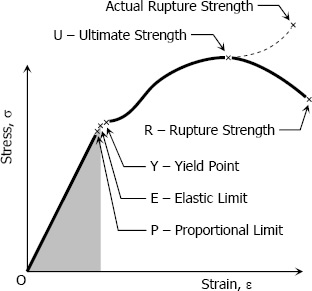
STRESS STRAIN DIAGRAM
![Tensile test and Stress-Strain Diagram [SubsTech]](https://www.substech.com/dokuwiki/lib/exe/fetch.php?w=&h=&cache=cache&media=tensile_specimen.png)
Proportional Limit (Hooke's Law)
From the origin O to the point called proportional limit, the stress-strain curve is a straight line.This linear relation between elongation and the axial force causing is called Hooke's Law that within the proportional limit, the stress is directly proportional to strain or
σ∝ε or σ=kε
The constant of proportionality k is called the Modulus of Elasticity E or Young's Modulus and is equal to the slope of the stress-strain diagram from O to P. Then
σ=Eε
Elastic LimitThe elastic limit is the limit beyond which the material will no longer go back to its original shape when the load is removed, or it is the maximum stress that may e developed such that there is no permanent or residual deformation when the load is entirely removed.
Yield Point
Yield point is the point at which the material will have an appreciable elongation or yielding without any increase in load.
Ultimate Strength
The maximum ordinate in the stress-strain diagram is the ultimate strength or tensile strength.
Rapture Strength
Rapture strength is the strength of the material at rupture. This is also known as the breaking strength.
Modulus of elasticity(E) : Within the elastic limits of materials i.e. within the limits in which Hook's law applies, it has been shown that
Stress / strain = constant
This constant is given by the symbol E and is termed as the modulus of elasticity or Young's modulus of elasticity
Thus 
Shear modulus also known as Modulus of rigidity(G) :It is the measure of the rigidity of the body, given by the ratio of shear stress to shear strain. Often denoted by G sometimes by S or μ.
| Definition | Shear modulus is the ratio of shear stress to shear strain in a body. |
| Symbol | G or S or μ |
| SI unit | Pascal (Pa), N/m2 |
| Formula | Shear stress/shear strain |
| Dimension formula | M1L-1T-2 |
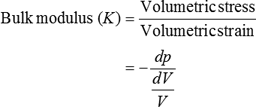
.The bulk modulus (K) -describes volumetric elasticity, or the tendency of an object to deform in all directions when uniformly loaded in all directions.
It is defined as volumetric stress over volumetric strain, and is the inverse of compressibility.
- G is the Shear Modulus
- E is the Young’s Modulus
- K is the Bulk Modulus
- υ is Poisson’s Ratio
Elastic moduli & the relationship between them
Relation between E, G and u :
Let us establish a relation among the elastic constants E,G and u. Consider a cube of material of side ‘a' subjected to the action of the shear and complementary shear stresses as shown in the figure and producing the strained shape as shown in the figure below.
Assuming that the strains are small and the angle A C B may be taken as 450.

Therefore strain on the diagonal OA
= Change in length / original length
Since angle between OA and OB is very small hence OA @ OB therefore BC, is the change in the length of the diagonal OA

Now this shear stress system is equivalent or can be replaced by a system of direct stresses at 450 as shown below. One set will be compressive, the other tensile, and both will be equal in value to the applied shear strain.

Thus, for the direct state of stress system which applies along the diagonals:

Relation between E, K and u :
Consider a cube subjected to three equal stresses s as shown in the figure below

The total strain in one direction or along one edge due to the application of hydrostatic stress or volumetric stress s is given as

Relation between E, G and K :
The relationship between E, G and K can be easily determained by eliminating u from the already derived relations
E = 2 G ( 1 + u ) and E = 3 K ( 1 - u )
Thus, the following relationship may be obtained


